
The Crisis of Mismanagement: Why Meta-Management is the Only Way to Combat the UK’s Workforce Mental Health Epidemic
In a world increasingly dominated by Artificial Intelligence (AI) and facing intense economic uncertainty, our human capital is the only true differentiator we have left. Yet we consistently treat our workforce not as assets to be nurtured and developed, but merely as resources to be coordinated.
This approach has led to a national crisis. At our organisation, Impact Mental Health, we work daily with individuals desperate to re-enter the labour market, many of whom come to us with a worrying shared history: long-term absenteeism driven by stress, anxiety, and clinical depression. These devastating issues are often, and tragically, traceable to one root cause: poor management, mismanagement, and managers who are insufficiently trained, making poor decisions without the knowledge, training, or experience required to support their employees genuinely.
The Delegating Dilemma: Process vs. Purpose
I am not suggesting we stop delegating; that would negate the very purpose of having a workforce. But we must be acutely aware that there are two fundamentally different types of delegation, and one is rapidly replacing the other:
The Wrong Delegation (The Coordinator)
Tasks are passed on to lighten the manager’s own workload (easement), often without adequate context, support, or training.
Outcome: Employee feels overwhelmed, under-resourced, and fundamentally unvalued.
The Right Delegation (The Coach)
Tasks are intentional stretch assignments that build capacity, skills, and confidence and contribute to the employee’s career development.
Outcome: Employee feels empowered, skilled, and motivated.
When delegation is thoughtless, it creates crippling stress. When it is purposeful and supported? When it is an act of coaching, it builds the mental resilience our workforce desperately needs.
The UK’s Human Cost: A Call for Meta-Management
The stakes are higher than ever, and the numbers illustrate the urgent need for a change in management philosophy:
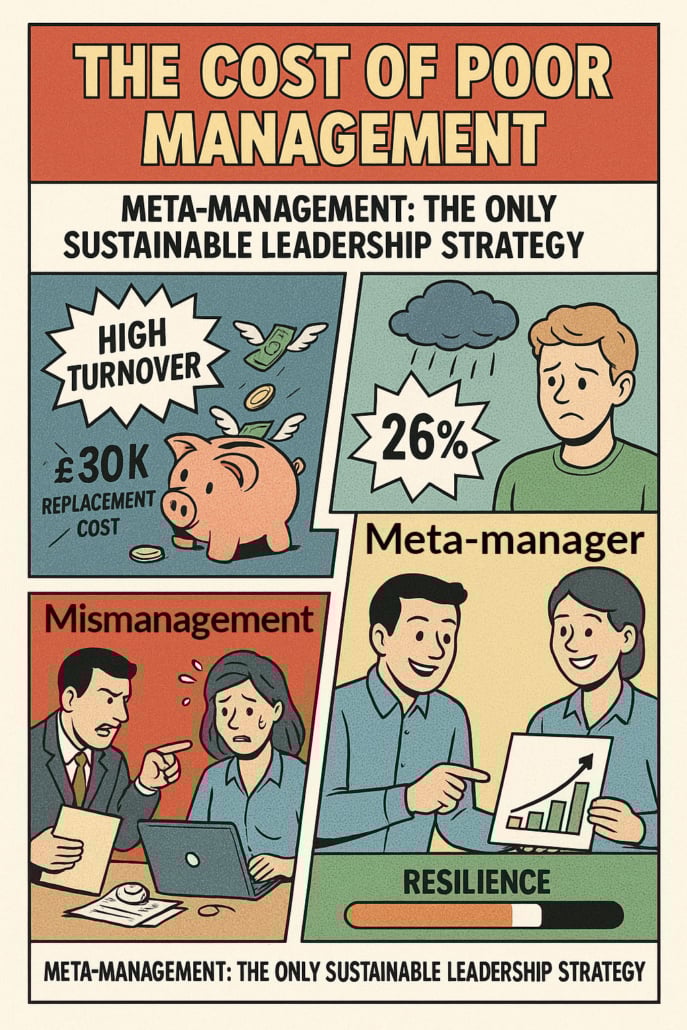
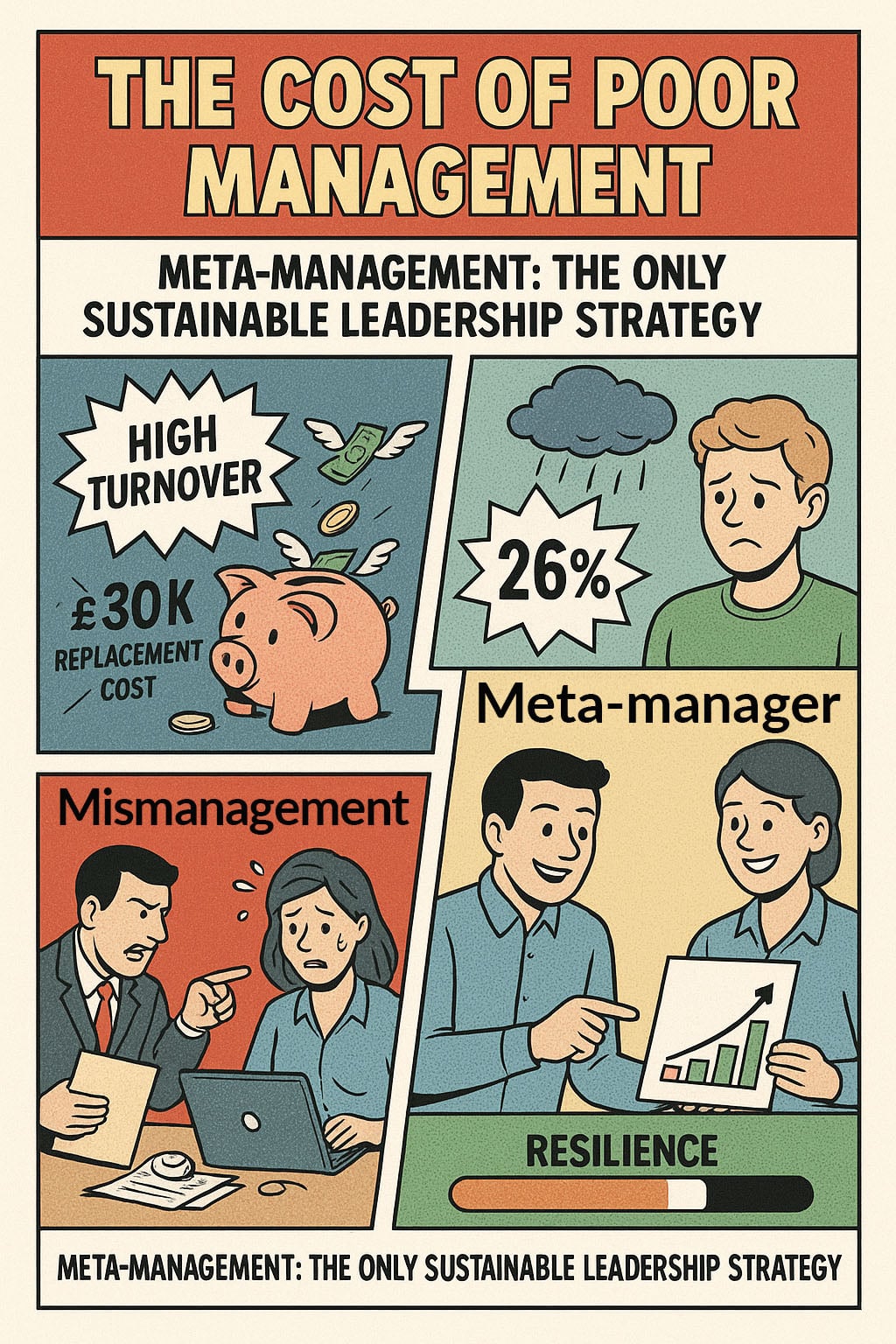
- The Retention Crisis: The average staff turnover rate for UK workers is currently 34% to 35% [Source: CIPD/Vestd Workforce Statistics]. The cost of replacing a single mid-level employee is upwards of £30,000 [Source: Oxford Economics/Ballards LLP Cost of Staff Turnover Reports]. We are literally haemorrhaging capital by failing to invest in the human element of our business.
- The Youth Mental Health Emergency: Adults aged 16 to 29 are the most likely age group to experience depressive symptoms, with 26% reporting moderate to severe symptoms [Source: Office for National Statistics (ONS) Adult Psychiatric Morbidity Survey/Quarterly Data]. Furthermore, 35% of 18-to-24-year-olds in employment report needing to take time off work due to poor mental health or stress [Source: YoungMinds/Mental Health Foundation Data]. These are not weak individuals; they are a vulnerable workforce seeking leadership that is equipped to manage the human system.
This is why we must embrace Meta-Management (MM).
Meta-Management is the transcendental shift from coldly coordinating people as numbers to actively building and valuing them as individuals. It recognises that to secure high, sustainable performance in a turbulent world, managers must master the art of psychological fortitude. MM managers are fortitude architects, not comfort providers. They understand that resilience is not an inherent trait, but a skill developed through psychological safety and consistent, purposeful coaching.
The shift to human-centric leadership is often met with the critique that it promotes a ‘soft society’. This view fundamentally misunderstands MM. MM is a high-performance, high-resilience framework. Capacity Coaching is the antithesis of coddling; it is a challenging process designed to build autonomous, high-agency problem-solvers. The MM leader equips people with the emotional intelligence and self-awareness necessary to sustain peak performance through continuous turbulence.
If you are a leader, your next investment shouldn’t be another piece of software, but in developing the empathic, coaching, and decision-making skills of your middle managers. Research shows that 94% of employees would stay longer if their company invested in their learning and development [Source: LinkedIn Workplace Learning Report]. The art of management must be restored—because the financial and human cost of losing it is simply too high.
Ask yourself: Are your managers delegating tasks, or are they coaching capacity?
The future of your workforce, and its health, depends on the answer.


Leave a Reply
Want to join the discussion?Feel free to contribute!