
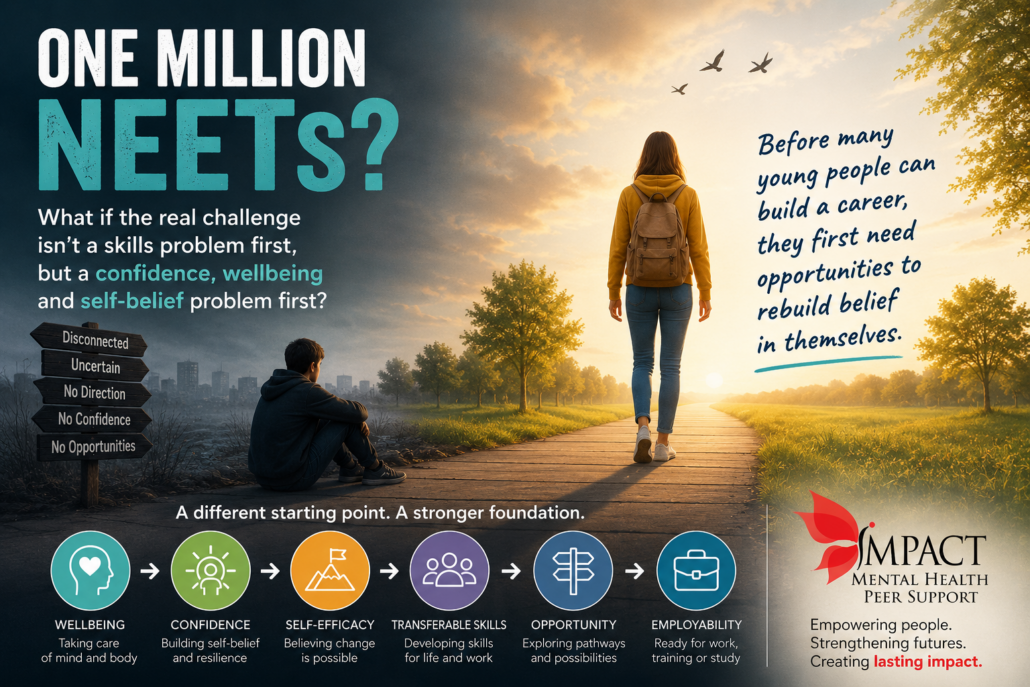
One Million NEETs? What If We’re Asking the Wrong Question?
One Million NEETs? What If We’re Asking the Wrong Question?
The latest projections suggest the number of young people not in education, employment or training (NEET) could exceed one million in the coming years.
As the debate gathers pace, the focus is understandably on employability, qualifications, skills and workforce participation.
All important issues.
But what if we’re asking the wrong question?
What if a significant proportion of NEET status is not a skills problem first, but a confidence, wellbeing and self-efficacy problem first?
Over recent weeks, I’ve been reading research into the growing number of young people who are economically inactive, alongside the longer-term impact of the pandemic on mental health and social participation.
One thought keeps returning:
The pandemic didn’t just interrupt learning. It interrupted identity formation.
For many young people, adolescence and early adulthood are the years when they begin to discover who they are and where they fit in the world.
It is a time of first jobs, volunteering opportunities, apprenticeships, college experiences, friendships, challenges and growing independence.
It is often through these experiences that young people begin to answer some of life’s most important questions:
What am I good at?
What do I have to offer?
Where do I belong?
What might my future look like?
For many, those opportunities were disrupted, delayed or removed altogether.
The impact wasn’t simply educational.
For some young people, it affected their confidence, self-belief, and sense of future possibility.
This matters because before someone writes a CV, attends an interview or starts a training programme, they need to believe they can succeed.
Psychologist Albert Bandura’s work on self-efficacy highlighted the importance of believing that our actions can influence outcomes.
If a young person no longer believes their efforts will make a difference, motivation naturally declines.
No amount of CV writing workshops can fully address that.
Perhaps this is why many of the challenges facing young people today appear to sit at the intersection of mental wellbeing, confidence and employability.
Anxiety can affect communication.
Low self-esteem can affect aspirations.
A lack of confidence can prevent someone from applying for opportunities they are more than capable of succeeding in.
In this context, transferable skills go far beyond employment.
Communication.
Problem solving.
Adaptability.
Resilience.
Teamwork.
These are not simply workplace skills.
They are confidence-building skills.
They help people accumulate evidence that they are capable, resourceful and able to contribute.
And confidence is rarely built through being told what we can do.
It is built through experiencing what we can do.
Perhaps this is where the conversation needs to evolve.
Instead of starting with CVs and interviews, maybe we should begin with wellbeing, confidence, self-belief and transferable skills.
Not because employment is less important.
But because these foundations often make employment possible.
Before many young people can build a career, they need opportunities to rebuild their confidence.
The challenge of NEETs is not solely an employment issue.
It is also a wellbeing issue.
A confidence issue.
A participation issue.
Ultimately, the question that interests me most is not:
“How do we get young people into work?”
It is:
“What helps a person reconnect with hope, capability and possibility after a period of disconnection?”
Because when we understand the answer to that question, employment may become one of many positive outcomes that follow.
I’d be interested in hearing the views of others working in youth development, employability, education, mental health, and community support.
Are we placing enough emphasis on confidence, self-efficacy and wellbeing when supporting young people into employment and training?


Leave a Reply
Want to join the discussion?Feel free to contribute!